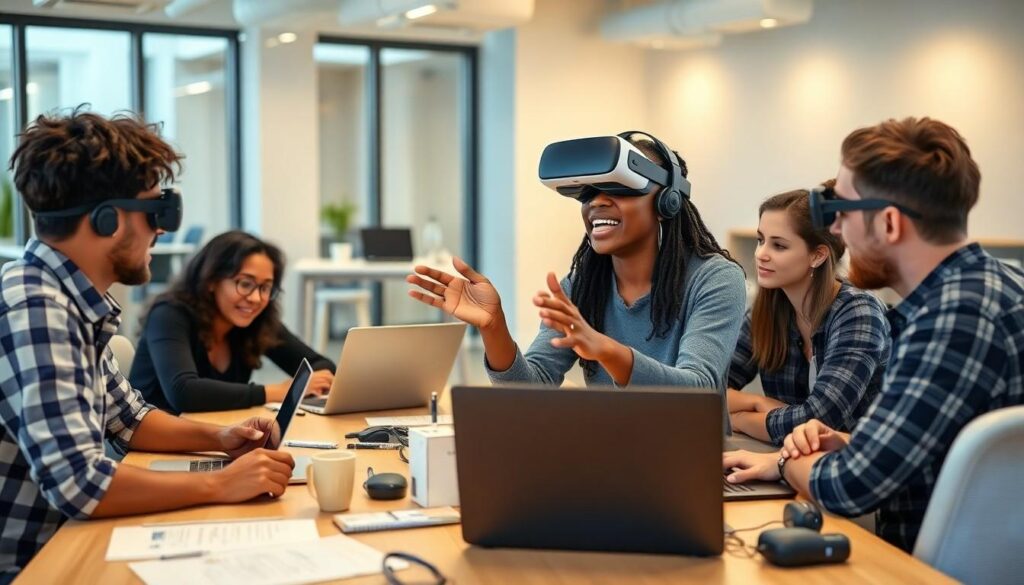
Imagine stepping into a classroom where textbooks come to life and complex concepts turn into interactive experiences. Augmented reality (AR) is breaking down the walls of traditional education, transforming mundane lessons into breathtaking adventures. It’s like having a magic wand that makes learning not just informative but downright fun.
Table of Contents
ToggleOverview of AR for Education
Augmented reality (AR) significantly reshapes the educational landscape. It allows students to interact with digital elements in real-world settings, making lessons more tangible. With AR, complex subjects like anatomy, physics, or history transform into immersive experiences. Students can visualize intricate structures, conduct virtual experiments, or explore historical sites in detail.
Numerous educational tools leverage AR to enhance learning outcomes. Platforms such as Google Expeditions and Merge Cube provide engaging activities. These tools enable educators to create interactive lessons that captivate students’ attention. By integrating AR into classrooms, teachers promote active participation and foster collaboration.
Research shows that students retain information better when engaging with interactive content. According to a study published in the Journal of Educational Technology, learners exposed to AR environments experienced a 70% increase in knowledge retention compared to traditional methods. Educators can harness this potential to tailor instruction to diverse learning styles.
Implementing AR in the curriculum comes with challenges. Schools require appropriate devices, internet access, and ongoing training for teachers. Budget constraints may hinder widespread adoption, limiting AR’s impact in some areas. Nevertheless, as technology advances and costs decrease, integration becomes more feasible.
Success stories abound in various educational settings. Institutions that have adopted AR report improved student engagement and motivation. A high school in California used AR to enhance biology lessons, resulting in a noticeable improvement in test scores. Other educators note the effectiveness of AR in special education, helping students with disabilities grasp fundamental concepts.
AR stands out as a powerful tool in modern education. Its ability to make learning interactive and enjoyable positions AR as a vital resource for future classrooms. Schools that invest in AR technology contribute to a more dynamic educational experience, preparing students for an increasingly digital world.
Benefits of AR in the Classroom
Augmented reality (AR) offers significant advantages for the classroom experience, driving student participation and learning outcomes.
Enhanced Engagement
AR transforms standard lessons into dynamic experiences. Students interact with three-dimensional models and virtual simulations, capturing their interest more than traditional methods. Activities designed around AR foster collaboration among peers, encouraging teamwork on projects. Engaging tools such as Google Expeditions and Merge Cube draw students into immersive environments. As a result, lessons become memorable experiences rather than monotonous tasks.
Improved Retention
AR increases knowledge retention significantly. Research shows a 70% boost in information retention when students engage with AR content. Visualizing complex topics helps clarify concepts, allowing students to grasp information more fully. Creating interactive scenarios enables learners to apply knowledge in real-world contexts. Frequent exposure to immersive learning environments reinforces understanding, leading to better test performance and academic success.
Applications of AR in Various Subjects
AR enhances educational experiences across subjects, making lessons engaging and memorable.
Science and Biology
AR transforms science and biology lessons by allowing students to explore intricate processes. They can visualize molecular structures and cellular functions through immersive 3D models. Students conduct virtual dissections, gaining practical insights without the constraints of real-world resources. Moreover, AR simulations enable experimentation with biological systems, fostering hands-on learning. A study found that students exhibited a 60% increase in understanding complex biological concepts when using AR tools compared to traditional methods. These technologies make science tangible and accessible, sparking curiosity and motivation.
History and Geography
History and geography benefit from AR through interactive timelines and vivid historical reenactments. Students can take virtual field trips to ancient civilizations, experiencing historical events in real-time. They engage with significant artifacts and locations, developing a personal connection to history. AR applications, such as Google Expeditions, offer immersive experiences that bring past cultures to life. Studies show that learners retain 80% more information about historical subjects when utilizing AR features. Such experiences deepen their understanding and broaden perspectives, making history relevant and engaging.
Mathematics
Mathematics education leverages AR to visualize abstract concepts and improve comprehension. Students manipulate 3D geometric figures, gaining insights into spatial relationships. Interactive AR apps allow learners to visualize solving equations and graphing functions dynamically. Enhancing problem-solving skills becomes easier with tangible examples. Research indicates that students experience a 70% increase in problem-solving capabilities when AR is integrated into math lessons. Engaging with these tools encourages exploration and curiosity, making math less intimidating and more enjoyable.
Challenges and Limitations
Augmented reality (AR) in education faces several challenges and limitations that hinder widespread adoption. Various obstacles impede effective integration, from technology access to teacher training.
Technology Access
Access to advanced technology poses a significant challenge for implementing AR in classrooms. Many students lack the required devices, such as tablets or smartphones. Schools in underfunded areas struggle to provide adequate resources, limiting AR’s potential to enhance learning experiences. Internet connectivity remains another barrier; reliable high-speed connections are essential for effective AR applications. Educational institutions unable to secure such connectivity miss out on the benefits of interactive learning experiences. Furthermore, disparities in access create an uneven playing field for students, potentially widening the achievement gap. Institutions need innovative solutions to bridge this digital divide and ensure equal opportunities for all learners.
Teacher Training
Successful AR implementation hinges on adequate teacher training. Educators must be comfortable using AR technology to effectively facilitate learning. Many teachers currently lack the requisite skills, facing barriers to accessing professional development programs. Comprehensive training programs that cover both AR tools and pedagogical strategies can empower educators to leverage AR’s full potential. Moreover, ongoing support in the form of workshops and peer collaboration can enhance teachers’ confidence. Schools also need to prioritize training resources to ensure educators can adapt to this evolving medium seamlessly. Without proper training, the effectiveness of AR in the classroom diminishes significantly, limiting its impact on student engagement and learning outcomes.
Future Trends in AR for Education
Emerging trends in AR technology continue to shape educational practices. Increased integration of artificial intelligence with AR enhances personalized learning experiences for students. Adaptive learning platforms analyze individual performance, providing tailored content based on each student’s needs.
Enhanced collaboration tools using AR promote teamwork among students. Virtual classrooms enable real-time interactions with peers and teachers, fostering a sense of community regardless of location. Educators utilize these tools to create collaborative projects that engage students effectively.
AR’s role in gamification is gaining momentum. Game-based learning environments allow students to explore subjects through simulations and challenges. Research shows a 65% increase in motivation among students involved in gamified AR activities.
Continued advancement of AR hardware and software supports diverse educational applications. Newer devices offer improved access and presentation capabilities, changing how students engage with content. Schools are recognizing the benefits of incorporating AR into various subject areas, enhancing traditional teaching methods.
Increased focus on lifelong learning will influence AR applications in adult education and professional development. Organizations are starting to adopt AR solutions for training purposes, providing immersive experiences that simulate real-life scenarios. Training outcomes show a 55% improvement in retention rates when participants engage with AR content.
Ethics and accessibility will continue to drive discussions around AR in education. Inclusive design practices prioritize equal access to AR resources, ensuring all students can benefit from innovations. Ongoing research aims to address these concerns and develop standards for responsible AR use in educational settings.
These trends demonstrate AR’s potential to revolutionize educational experiences, paving the way for future advancements.
Augmented reality is reshaping education by making learning more engaging and interactive. Its ability to turn complex subjects into immersive experiences enhances student understanding and retention. As schools navigate the challenges of integrating AR, the potential benefits for student engagement and collaboration are undeniable.
With ongoing advancements in technology and a focus on personalized learning, AR’s role in education will likely continue to grow. The commitment to equitable access and comprehensive teacher training is essential for maximizing AR’s impact. Embracing these innovations can lead to a more dynamic educational landscape, preparing students for the demands of a digital future.